How to Start Forex Trading as a Beginner
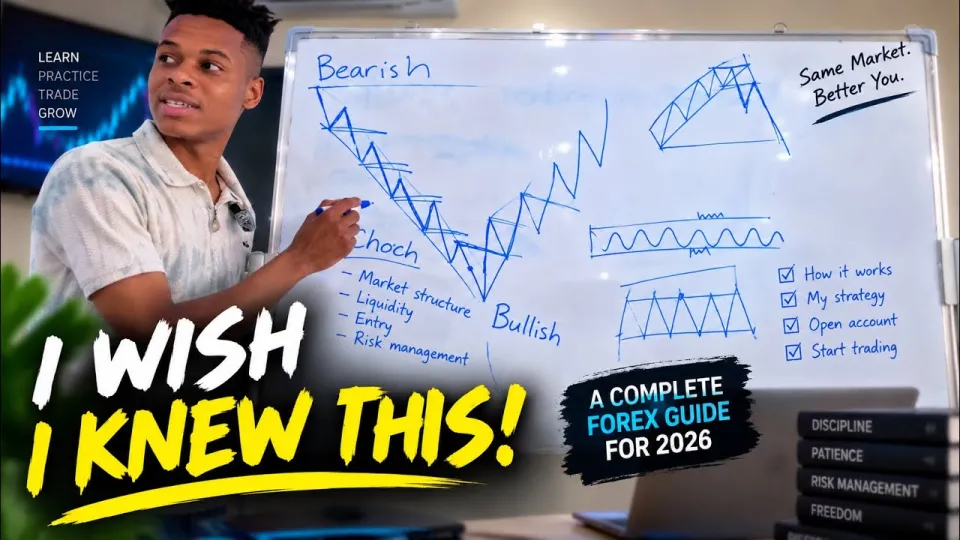
Video: How To Start Forex Trading For Beginners in 2026 (Full Guide + My Strategy)
Need articles like this for your video? They help promote it on YouTube and Google — order them in the Telegram bot @sat_sit_bot. It writes articles around your video, embeds the video and publishes them on popular niche websites (no ads). Try it free: 50 articles on us.
· based on the channel Carl Fx
Key takeaways
- Forex is an over-the-counter market where currencies are traded in pairs 24 hours a day, five days a week.
- A beginner path: demo account first, then a small live account with 1–2% risk per trade.
- Market structure (higher highs and higher lows vs lower highs and lower lows) is the base for reading price action.
- A simple strategy needs three parts: a market bias, an entry trigger and a fixed stop-loss.
- Leverage amplifies both gains and losses; position size, not confidence, controls risk.
Forex trading is the buying and selling of currency pairs on an over-the-counter market that runs 24 hours a day, five days a week. For a beginner, the practical starting point is a demo account, a written trading plan and strict risk limits — not a big deposit. Carl Fx, who runs the channel behind the walkthrough below, frames the whole process the same way: learn how the market works, open an account through a regulated broker such as TFC Global Markets, study market structure and price action, then practise one simple strategy until it is repeatable.
What forex trading actually is
Forex is a decentralised market where national currencies are quoted in pairs, and the price of a pair reflects how much of the quote currency one unit of the base currency buys. EUR/USD at 1.0850, for example, means one euro costs 1.0850 US dollars. There is no central exchange: banks, brokers and liquidity providers quote prices to each other, and retail traders reach that flow through a broker.
The most traded pairs — EUR/USD, USD/JPY, GBP/USD, USD/CHF — carry the tightest spreads and the deepest liquidity. Exotic pairs such as USD/ZAR or USD/TRY can move violently on local news and are a poor first choice for someone still learning the mechanics.
Three structural facts shape every beginner's experience:
- Sessions matter. London and New York overlap in the late-morning European hours and produce the largest share of daily volatility; the Asian session is usually quieter.
- Costs are real. Spread, commission and swap (the overnight financing charge) eat into every result. A strategy that only works with zero costs does not work.
- Leverage is a tool, not a gift. At 1:100 leverage, a 1% move against a fully leveraged position wipes out the account. Professional traders rarely risk more than 1–2% of equity on a single idea.
Setting up a trading account step by step
Opening an account is a short administrative process, but the choices made in it determine how long a beginner survives. Work through it in order:
- Choose the broker. Check regulation, client-fund segregation, spread on the pairs you intend to trade, and withdrawal terms. Carl Fx discloses that he owns TFC Global Markets and that his sign-up link promotes his own brokerage — a useful reminder to read the terms yourself before depositing.
- Register and verify. Complete the KYC step with an ID and proof of address; regulated brokers require it before any withdrawal.
- Open a demo account first. Trade the same pairs, lot sizes and strategy you plan to use live, for at least a month or a few dozen trades.
- Fund a small live account. Start with an amount whose loss would not change your life — a few hundred dollars is enough to learn execution and psychology.
- Set the platform up. On MetaTrader 4 or 5, save a template with your moving averages, mark up the higher timeframes and set a default stop-loss distance.
- Write the plan down. Entry rules, exit rules, maximum daily loss, maximum trades per day. If it is not written, it is not a plan.
Reading market structure and price action
Market structure is the sequence of swing highs and swing lows on a chart, and it tells you which side of the market is currently in control. In a bullish market, price prints higher highs and higher lows; in a bearish market, lower highs and lower lows. When that sequence breaks — a lower low inside an uptrend, for instance — the market is signalling a possible shift, not a guaranteed reversal.
Price action is the study of how candles behave at those levels. A beginner needs only a handful of concepts:
- Support and resistance. Zones where price has repeatedly reacted, drawn on the higher timeframes (four-hour and daily) first.
- Break of structure. A close beyond the last swing point, which confirms the direction of the current leg.
- Pullback versus reversal. A pullback returns to a level inside the trend and continues; a reversal breaks the structure and holds the break.
- Candlestick closes, not wicks. Decisions based on closed candles avoid most false signals.
A workable routine is to mark the daily structure, drop to the one-hour or fifteen-minute chart for entries, and never take a trade that contradicts the higher-timeframe bias.
A simple beginner strategy
A simple strategy is a fixed set of conditions that tells you when to enter, where to place the stop and where to take profit — the same three answers every time. One structure-based template looks like this:
- Bias. On the daily chart, identify whether structure is bullish or bearish.
- Zone. Mark the last significant support (in an uptrend) or resistance (in a downtrend) where price is likely to react.
- Trigger. Wait for price to reach the zone and print a confirmation candle in the direction of the bias.
- Entry and stop. Enter on the close of the confirmation candle; place the stop beyond the swing that created the zone.
- Target. Aim for the next structural level, with a minimum reward-to-risk of 2:1.
- Risk. Size the position so the stop equals 1% of account equity — no exceptions, no widening.
That is deliberately plain. The edge does not come from complexity; it comes from executing the same rules over hundreds of trades and recording the results in a journal so that the win rate and average reward-to-risk can be measured rather than guessed.
Mistakes that end beginner accounts early
Most beginner accounts fail for behavioural reasons rather than analytical ones. The recurring errors are predictable:
- Trading without a stop-loss, or moving the stop further away to avoid being wrong.
- Over-leveraging because a small account feels slow — the fastest route to a blown balance.
- Revenge trading after a loss, doubling size to win it back the same session.
- Strategy hopping every week, so no method ever gets a fair sample of trades.
- Skipping the demo phase, then learning risk management with real money.
- Following signals blindly without understanding why a position was opened.
A useful guardrail is a hard daily loss limit — for example, stop for the day after two losses or a 3% drawdown — written into the plan before the session starts.
Common beginner questions answered
Viewers of the guide repeatedly raise the same practical worries, and they deserve direct answers.
"Can I start this week with a small account?" Yes, provided the first weeks are on demo and the first live deposit is money you can afford to lose. Execution speed and psychology change completely once real capital is at stake, so the transition should be gradual.
"I struggle to open a live account." Verification is usually the sticking point: documents must match the name and address exactly, and some regions are restricted by the broker's licence. Contact support before depositing rather than after.
"I understand the words but not the chart." That is normal in the first month. Chart examples and marked-up screenshots help far more than more theory; take one concept — say, break of structure — and find twenty examples on historical charts before trading it.
"How long before it becomes profitable?" There is no fixed timeline. Consistency comes from a journal, a fixed strategy and controlled risk; anyone promising a number of weeks is selling something.
Useful links
- Broker registration used in the walkthrough: TFC Global Markets sign-up
- Free Telegram community: https://t.me/carlsmcforex
Bottom line
Forex rewards process over prediction: a beginner who learns market structure, trades one simple strategy on demo, risks 1–2% per trade and keeps a journal is already ahead of most of the retail crowd. The guide from Carl Fx is a solid starting map because it covers the unglamorous parts — account setup, structure, risk and the mistakes that empty accounts — rather than promising overnight returns. If you want to follow that path, start with a demo, then open a live account through TFC Global Markets when the rules feel automatic. Trading carries significant risk and profits are never guaranteed; practise first and never deposit money you cannot afford to lose.
Questions & answers
How much money do I need to start forex trading?
There is no fixed minimum, but a beginner should deposit only an amount whose loss would not affect their finances — often a few hundred dollars. The size of the account matters less than risking 1–2% per trade, because that rule keeps a small balance alive long enough to learn.
Is a demo account really necessary before trading live?
Yes, for most beginners. A demo lets you test the platform, the strategy and your own discipline without financial consequences. Treat it seriously — same lot sizes and same rules — for at least a month or several dozen trades before switching to real money.
What is market structure and why does it matter?
Market structure is the pattern of swing highs and swing lows that shows whether buyers or sellers control the chart. A bullish structure prints higher highs and higher lows, a bearish one the opposite. Reading it first prevents taking trades against the dominant direction.
Why do most beginner forex accounts fail?
The usual causes are behavioural: no stop-loss, oversized positions, revenge trading after a loss and switching strategies every week. A written plan with a daily loss limit and a trade journal addresses most of these problems before they cost real money.
Source: How To Start Forex Trading For Beginners in 2026 (Full Guide + My Strategy) · Markdown version