Meme Coin Entry Strategy That Beats FOMO
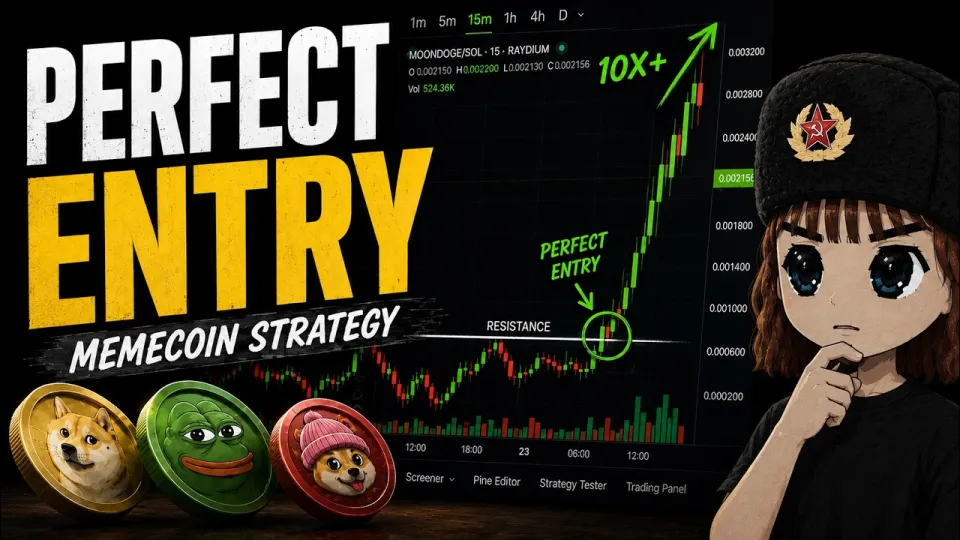
Video: How I Find the PERFECT Entry on Memecoins 📈 (Full Strategy)
Need articles like this for your video? They help promote it on YouTube and Google — order them in the Telegram bot @sat_sit_bot. It writes articles around your video, embeds the video and publishes them on popular niche websites (no ads). Try it free: 50 articles on us.
· based on the channel starwifpump
Key takeaways
- Most meme coin losses come from bad timing, not bad coin selection — entry sets the risk-to-reward ratio.
- A valid setup needs momentum confirmation plus a pullback to a support level, not a chase into a green candle.
- Pre-defined invalidation (a broken support or lost momentum) is what tells you NOT to enter.
- Risk, exits and profit-taking are planned before the trade, not improvised after it.
- Patience for the right setup is the core skill; FOMO entries are the default failure mode.
A meme coin is a highly volatile token whose price is driven mostly by attention and narrative rather than fundamentals, so the entry point matters more than the coin pick. The practical answer to "how do I enter a meme coin" is a repeatable process: confirm momentum, wait for a pullback into support, define invalidation in advance, and size the position so a wrong call costs little. The full breakdown of that process comes from the starwifpump video "How I Find the PERFECT Entry on Memecoins", and the tool stack referenced in it is available through the Plasma Telegram early-access channel.
Why meme coin entries fail more often than picks
Most meme coin traders do not lose because they chose the wrong token; they lose because they bought at the wrong moment. A token that goes from launch to a local top in hours leaves a very narrow window where risk-to-reward is acceptable, and buying the vertical green candle puts the stop far below the entry while the upside is already partly spent.
The same coin can be a good trade or a bad trade depending on where you enter. Entering after a confirmed move and a controlled pullback compresses the distance to invalidation, which is exactly what improves the risk-to-reward ratio. Chasing the pump does the opposite: it widens the stop and shrinks the remaining upside.
This is why the process below is built around timing and confirmation rather than around finding a "gem" before anyone else.
How to read a meme coin chart before entering
Chart analysis on a meme coin starts with structure, not indicators: where the price launched, where the first real consolidation formed, and which level has already been defended more than once. On low-cap tokens the chart is thin and noisy, so the useful information is concentrated in a handful of levels and in the volume behaviour around them.
A workable pre-entry checklist:
- Identify the launch zone and the first impulse leg — this defines the range you are trading.
- Mark the support levels that price has already bounced from, including the consolidation floor after the first leg.
- Check whether volume expands on up-moves and contracts during pullbacks — expansion on red candles is a warning.
- Note the liquidity depth and how easily a single sell can move the price.
- Decide in advance which chart behaviour invalidates the whole idea.
If the chart gives no clean level to lean on, there is no setup — there is only a guess with a token attached to it.
Momentum without chasing the pump
Momentum is useful only when it is read as confirmation, not as an invitation to buy the top of a candle. A healthy momentum signature on a meme coin looks like a strong impulse leg followed by a shallow, low-volume pullback that holds above the prior breakout level. That sequence shows buyers are still in control while the crowd is taking profit.
The distinction matters because the two situations look similar on a 1-minute chart and behave very differently afterwards:
- Constructive momentum: higher lows, pullbacks that hold support, volume fading on red candles, and a fast reclaim after a dip.
- Exhaustion: a vertical candle with no consolidation, wicks that keep getting longer, and volume spiking on the way down rather than up.
The second pattern is where late buyers get trapped. Waiting for the pullback costs a few percent of upside and removes most of the drawdown risk.
Pullbacks and support levels as entry triggers
A pullback entry means buying into weakness at a level you have already identified, rather than buying into strength at a price you have not tested. On meme coins this is the single most repeatable improvement to entry quality, because the level gives you a reference point for both the stop and the target.
The mechanics are simple: mark the support, wait for price to reach it, and require a reaction — a wick that gets bought, a reclaim of the level, or a volume shift — before acting. If price slices through the level and does not reclaim it, the setup is gone and the correct action is to stand aside. Support that was never tested is not support; it is a line drawn on hope.
Red flags that say do not enter
Knowing when to skip a trade is as valuable as knowing when to take one, because most bad entries are visible in advance. The clearest signals against entering a meme coin are a parabolic move with no consolidation, a breakdown of the level you were planning to buy, and volume that keeps rising while price stalls.
Other warnings worth respecting:
- Price is far above any recent support, so the stop would have to be unreasonably wide.
- The move is entirely driven by a single candle with no follow-through.
- Liquidity is thin enough that your own exit would move the market.
- You cannot state in one sentence why the trade should work.
When several of these appear together, the trade is a lottery ticket, not a setup.
Planning risk, exits and profit-taking first
Risk planning happens before the entry, not after it. The position size should be derived from the distance to invalidation: if the level that proves you wrong is 20% below the entry, the position must be small enough that a 20% loss is acceptable. Meme coins can also gap through a stop in seconds, so treat the stop as a best-case exit rather than a guarantee.
A practical structure used by experienced traders:
- Define the invalidation level and the maximum acceptable loss on the trade.
- Size the position from that loss, never from the amount of capital available.
- Set partial profit targets at the prior high and at obvious round levels, and take some off on the way up.
- Trail the remainder behind higher lows rather than holding for an imaginary final top.
This is the part beginners skip, and it is the reason a good entry still turns into a loss when the exit is improvised.
Common beginner questions about meme coin entries
Beginners usually ask the same practical things: which tools to use, whether the approach transfers across chains, and how to avoid repeating a loss. The tools question is legitimate — a terminal that supports paper trading alongside real execution lets you test an entry process without risking capital, which is exactly what the Plasma early-access group linked at the top of this article is for.
The chain question matters less than the process. Solana meme coins move faster and have different liquidity profiles than tokens on other networks, but momentum, pullback and invalidation logic apply the same way; only the speed and the slippage change. The harder question is emotional: traders who lost money often want to re-enter immediately with a smaller balance, which is the same FOMO pattern that caused the loss. A written checklist and a fixed position size are the practical defence.
Useful links
- Plasma Telegram early access — tool updates, setup help and paper-trading access.
- https://discord.com/invite/fr6zzYyBxC — community and live trade discussion.
- https://trade.padre.gg/rk/star — trading terminal access.
- https://solpump.com/a/STARGOAT — Solpump platform.
- https://x.com/starwifpump — the author's updates on X.
Bottom line
A meme coin entry is a process, not a moment of inspiration: confirm momentum, buy the pullback into a real support level, define invalidation before the position exists, and size the trade so being wrong is survivable. Most losses in this niche come from timing and from skipping the exit plan, not from picking an unknown token. The starwifpump breakdown is a useful template because it treats entry, risk and profit-taking as one decision rather than three separate ones. If you want the tooling that supports that workflow, start with the Plasma Telegram early-access channel.
Questions & answers
Do I need a special terminal to trade meme coins, or is a normal exchange enough?
A standard exchange works for tokens that are already listed, but most meme coin entries happen on-chain where speed and slippage control matter. A dedicated terminal that combines charting, sniping and position tracking — and ideally paper trading — lets you practise the entry process before committing capital.
Does the same entry approach work on every chain, including newer ones?
The logic of momentum, pullback and invalidation transfers across chains, but the parameters do not. Faster networks produce sharper moves and thinner liquidity, so stops get hit more easily and slippage is larger. Adjust position size and expectations to the chain rather than changing the core process.
How do I stop entering out of FOMO when a coin is already pumping?
Write the setup down before you look at the chart: the support level, the invalidation point and the maximum loss. If the current price does not offer an entry that respects those numbers, the trade does not exist. Missing a move costs nothing; chasing one costs capital.
I lost money on meme coins — is it worth trying again?
Only with a changed process. Re-entering with a smaller balance but the same habits reproduces the same result. Paper trade the entry checklist first, keep position sizes small enough that a full loss does not affect you, and treat every trade as a test of the process rather than a recovery attempt.
Source: How I Find the PERFECT Entry on Memecoins 📈 (Full Strategy) · Markdown version